




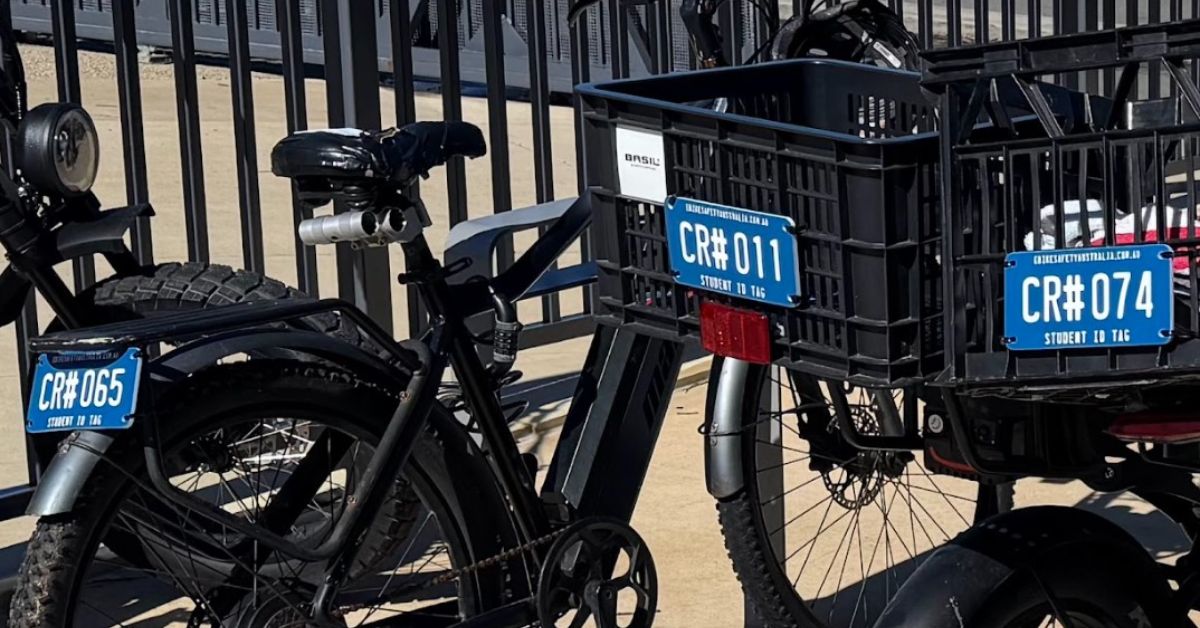
The Forest High School at Allambie Heights has adopted E-Bike Safety Australia’s student ID tag program, requiring students who ride e-bikes to school to complete an online safety course, pass a road rules quiz with a perfect score and attach a numbered ID tag to their bike before riding in school uniform.
The Forest High joins St Luke’s Grammar School in Dee Why as the second Northern Beaches school to roll out the program, which is delivered by E-Bike Safety Australia (EBSA), a Sutherland Shire-based organisation that has been operating the model across schools in Sydney’s south, the Illawarra and the NSW far north coast. For Allambie Heights and the surrounding northern suburbs corridor, the adoption of the program places a practical safety and accountability structure around a daily behaviour that has grown rapidly and, in some cases, raised genuine concern among residents and families along local roads and shared paths.
What the Program Requires
The EBSA program asks students who want to ride their e-bike to school to first complete a two-hour online training course covering road rules, helmet use, battery safety, riding etiquette and emergency procedures. Students must achieve 100 per cent on the final quiz to receive a digital licence and their school-specific ID tag. The tag carries a unique identifier linked to the student’s name at the school and must be attached to the e-bike whenever the rider is in school uniform.
Each EBSA ID tag carries a prefix that identifies the rider’s school, allowing any member of the public who witnesses unsafe riding to contact the school directly and quote the tag number. The school then manages the response under its own student wellbeing and safety policies, with EBSA holding no individual rider data. In practice, this means the accountability mechanism operates at the school level: if a resident near Allambie Heights sees a tagged student riding dangerously on a shared path or local road, they can contact The Forest High directly. The school can then counsel the student or withdraw their riding privileges for a defined period.
An Area Where E-Bike Use Has Grown Sharply
Allambie Heights sits in the middle section of the Northern Beaches peninsula, with students travelling to The Forest High from Allambie Heights, Beacon Hill, Brookvale, Curl Curl and surrounding suburbs. For many of those students, e-bikes have become the most practical and independent way to make the school journey, bypassing bus timetables and eliminating the need for a parent to provide transport.
E-bike numbers across NSW have grown from under 10,000 sales in 2017 to an estimated 760,000 e-bikes currently in circulation statewide, and that growth is reflected visibly in the daily movement of students around Northern Beaches schools. Legal e-bikes are limited under current NSW regulations to 250 watts of continuous rated power, following a December 2025 regulatory change reinstating the EN-15194 standard, and must not exceed 25 kilometres per hour under motor assistance. However, the existing legal framework does not require any demonstrated knowledge of road rules, a licence or registration to ride, leaving a significant gap that the EBSA school program steps into at a local level.
Community concern about e-bike behaviour in the Northern Beaches has been building for several years. As early as 2022, local schools were seeking safety resources for students riding to school, with young riders observed not wearing helmets correctly, carrying passengers and travelling at speeds that created risks for pedestrians on shared paths. The introduction of the ID tag system at The Forest High responds to that concern with a structured, measurable approach rather than general awareness messaging.
What the ID Tag System Delivers
The visible ID tag changes the dynamic around student e-bike riding in two important ways. First, it ensures that every tagged student has completed a structured safety education course and demonstrated knowledge of road rules before riding to school. Second, it removes the anonymity that allows poor riding behaviour to go unchallenged. A student who rides recklessly through a residential street near Allambie Heights or along the Manly Dam shared path can be identified, reported and held accountable by the school in a way that was previously impossible.
EBSA director Ben Horwood describes the combination of education and visible identification as the missing pieces in improving e-bike safety at the community level, observing that schools which have adopted the program consistently report calmer communities, safer young riders and improved relationships between the school and its surrounding neighbourhood. The Forest High’s decision to adopt the program reflects a recognition that the school has a role to play not just within its gates but in the shared public spaces students move through on their way to and from school each day.
Growing Use of E-Bikes Among Students
For Allambie Heights residents, the program brings accountability to a form of transport that has become a significant feature of daily life in the suburb, particularly around school hours. The local road network around The Forest High connects to Wakehurst Parkway and several shared cycling and walking paths that carry both students and community members throughout the day. When student e-bike riders and pedestrians or other path users share those spaces safely, the community benefits. When they do not, the consequences fall on residents who have had limited recourse to address the behaviour until now.
The EBSA program gives those residents a direct and practical channel for reporting concerns, and it gives The Forest High the tools to respond. E-Bike Safety Australia is currently in discussion with Narrabeen Sports High School about adopting the program, and further Northern Beaches schools are expected to follow.
Schools, families or community members wanting more information about the EBSA program can visit ebikesafetyaustralia.com.au.
Published 30-March-2026.

